
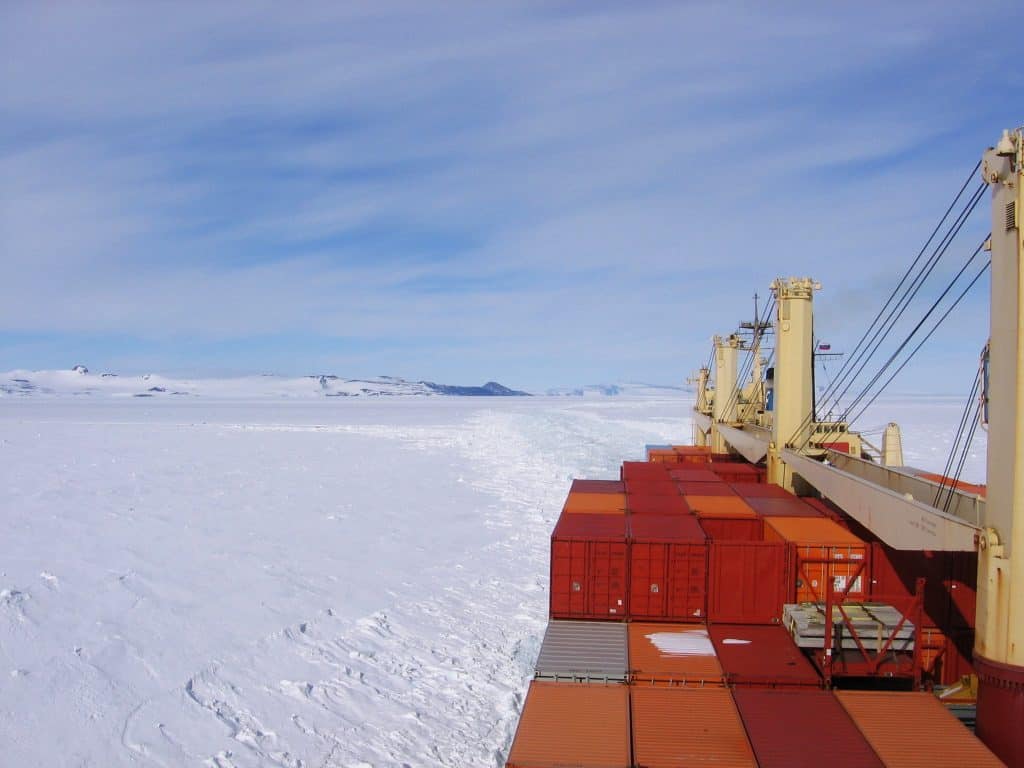
Snow and ice have disrupted terminal operations and transport links at major European ports in early January 2026, adding operational strain as the industry enters a critical period of Chinese New Year capacity planning. The weather disruptions come as carriers simultaneously press ahead with fresh terminal investments and as Cosco continues to expand its European hinterland logistics footprint, increasing complexity across key gateway ports.
Container freight rates have risen sharply on selected trades, with India–Europe spot rates climbing by approximately 50–60% in recent weeks, from around US$750 to US$1,200 per 40-foot container, according to market reporting (Hellenic Shipping News). The rate increases appear to reflect strategic capacity management rather than a broad-based demand recovery, as carriers deploy blank sailings to support pricing ahead of 2026 annual contract negotiations.
Carriers have announced 35 blank sailings over the next five weeks through early February, representing roughly 5% of planned departures. According to Drewry data, 51% of these cancellations are concentrated on transpacific eastbound routes, with a further 34% affecting Asia–Europe and Asia–Mediterranean services. The coordinated capacity reductions follow several months of freight rates that carriers have characterised as commercially unsustainable, underscoring the tactical importance of the current contract negotiation window.
Chinese New Year timing has further distorted seasonal patterns. Rather than the usual December peak followed by a January slowdown, carriers have front-loaded capacity into late January 2026. This contrasts with the more normalised seasonal behaviour observed across European trades in 2025, when markets weakened between January and May before strengthening mid-year.
Elevated airfreight costs have continued to support LCL demand, as shippers redirect smaller consignments toward ocean freight despite weather-related congestion.
Drewry’s World Container Index closed 2025 at US$2,213 per 40-foot container, with modest late-year gains on Asia–Europe and Mediterranean lanes as carriers maintained capacity discipline. Analysts expect the combined effects of weather-related disruption, Chinese New Year scheduling, and carrier-managed capacity to sustain freight rate volatility into the first quarter of 2026, particularly as annual contract negotiations intensify.
While weather-related disruption is inherently temporary, current pricing dynamics highlight how early-2026 freight outcomes are being shaped less by demand growth than by operational constraints and increasingly disciplined capacity management.
Data-led content box
Key operational and pricing indicators (early Q1 2026)
India–Europe spot rates: up ~50–60%, from ~US$750 to ~US$1,200 per FEU (Hellenic Shipping News)
Blank sailings announced (next five weeks): 35 sailings, ~5% of scheduled departures (Drewry)
Blank sailing distribution: 51% transpacific eastbound; 34% Asia–Europe / Asia–Mediterranean (Drewry)
Global airfreight rates: +17% year-on-year in early January (FreightWaves)
Drewry World Container Index (end-2025): US$2,213 per FEU (Drewry)